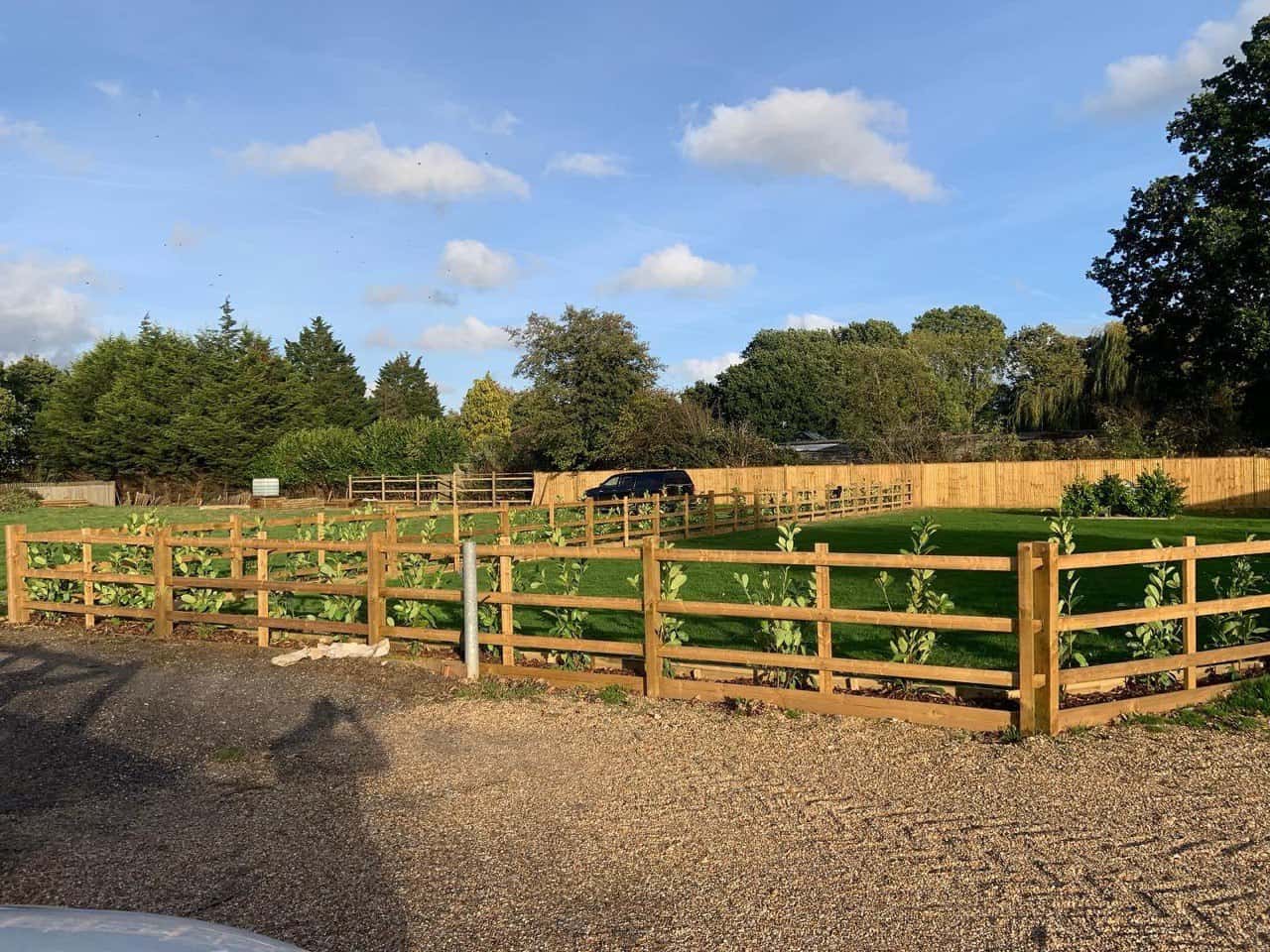
Why Is Post & Rail Fencing a Practical Choice for Defining Larger Boundaries?
Larger boundaries need a fencing solution that provides clear definition without necessarily creating a completely solid barrier. Whether the boundary runs alongside an extensive garden, paddock, field or other open area, the fencing needs to follow the landscape effectively while remaining visually appropriate for its surroundings.
Post & rail fencing is particularly well suited to this purpose. Its straightforward construction uses regularly spaced vertical posts connected by horizontal rails, creating a clearly identifiable boundary while retaining an open appearance. This makes it a practical option where enclosure and definition are required without the visual weight of continuous solid fencing.
For property owners in Cottenham, Cambridge, successful post & rail fencing depends on more than simply installing posts at intervals and attaching rails. Ground conditions, post stability, alignment, spacing, corners, changes in level and access points all influence how well a longer fence line performs. Professional installation brings these elements together to create a boundary suited to the individual site.
What Makes Post & Rail Fencing Suitable for Larger Boundaries?
Post & rail fencing has several characteristics that make it particularly useful across longer and more open boundaries.
These include:
- A clear and easily recognised boundary line
- An open appearance across larger spaces
- Suitability for long fence runs
- Adaptability to changing ground levels
- Straightforward integration with gates
- A traditional appearance suited to open surroundings
- Good visibility through and beyond the fence
- Individual components that can be assessed and repaired
- Flexibility around corners and changes in direction
- A relatively simple construction that places emphasis on correct installation
The effectiveness of the finished fence still depends heavily on how the posts, rails and complete boundary are planned and installed.
Post & Rail Clearly Defines Where a Boundary Runs
One of the main purposes of fencing is to make the division between different areas immediately understandable.
Across larger spaces, this can be more difficult to achieve without a continuous feature following the boundary.
Post & rail fencing creates a visible line without enclosing the entire view. The repeated posts and horizontal rails clearly identify where one area ends and another begins.
This makes it particularly useful where definition is the primary objective.
It Avoids Creating a Completely Solid Barrier
Solid fencing can be appropriate where privacy is important, but not every large boundary requires complete screening.
Post & rail fencing retains substantial open space between the rails.
This allows views to continue through the fence and can prevent a long boundary from feeling visually restrictive.
For larger gardens and open spaces, this characteristic can help the fencing perform its practical role without dominating the surroundings.
The Open Design Works Well Across Long Distances
A fence extending over a substantial distance becomes a significant visual feature.
A continuous solid surface can appear particularly prominent across a large area.
Post & rail fencing has a lighter visual structure because much of the boundary remains open.
This can make long runs feel less imposing while still creating a consistent and clearly defined edge.
Straight Fence Lines Can Create a Neat Appearance
Long boundaries often benefit from careful alignment.
When posts are positioned consistently and rails follow a clear line, post & rail fencing can create a simple and organised appearance.
Small alignment errors may be less noticeable on a short fence but can become increasingly obvious across a longer distance.
Setting out the fence accurately before installation is therefore particularly important on substantial boundaries.
Post Spacing Needs to Remain Consistent
The spacing between posts influences both appearance and construction.
Irregular intervals can make the fence line look disjointed and may create complications when fitting the rails.
Professional installation involves planning post positions around the intended rail lengths, corners, changes in direction and gate openings.
Consistency helps the complete boundary look intentional rather than assembled one section at a time.
Post Stability Is Fundamental
The posts provide the principal support for a post & rail fence.
If they move, lean or become unstable, the rails cannot maintain the intended line.
This makes post installation one of the most important stages of the project.
The ground needs to be considered so that each post can be installed appropriately for its position and the conditions along the boundary.
Ground Conditions Can Vary Along a Large Boundary
A long fence run may cross areas with different ground characteristics.
One section may be relatively firm while another behaves differently.
This variation matters because every post needs sufficient stability.
Treating the complete fence line as though the ground is identical from one end to the other can overlook local areas requiring greater attention during installation.
Changes in Ground Level Can Be Accommodated
Large boundaries are not always perfectly level.
The ground may rise gradually, fall away or contain several changes in elevation.
Post & rail fencing can be adapted to follow these variations.
The layout should be planned so that changes in rail position appear deliberate and the fence continues to define the boundary clearly without creating awkward transitions.
Gentle Slopes Need Careful Setting Out
A gradual slope can sometimes be more visually challenging than a pronounced change in level.
Over a long distance, small differences in post and rail position can become noticeable.
Careful setting out helps determine how the fence should follow the ground.
The objective is to create a consistent relationship between the fencing and the landscape rather than forcing an unsuitable level line across changing terrain.
Corners Require Proper Planning
Where a boundary changes direction, the corner becomes an important structural and visual point.
Rails approaching from different directions need to meet appropriately, while the post arrangement needs to reflect the layout.
Poorly planned corners can interrupt an otherwise neat fence line.
Considering these locations before installation allows the complete boundary to flow more naturally from one section to another.
Boundary Changes Should Be Planned Before Installation
Larger areas may contain several bends or changes in direction.
Trying to make these decisions while the fence is being constructed can lead to irregular post spacing and awkward rail lengths.
Setting out the intended route first helps identify where directional changes should occur.
This is particularly important where the fence needs to follow an established landscape feature or connect several different parts of a property.
Gates Can Be Incorporated Into Post & Rail Fencing
Larger boundaries frequently need access points.
A gate can be incorporated into the fence line so that access remains clearly defined rather than interrupting the boundary unexpectedly.
Gate locations should be considered during the initial layout.
The surrounding posts and fence sections can then be positioned appropriately around the opening.
Gate Posts Need to Reflect Their Different Role
Posts beside a gate have different demands placed on them from ordinary intermediate fence posts.
They form part of an access point and need to integrate correctly with both the gate and adjoining rails.
Planning these positions properly helps avoid creating a weak or visually inconsistent section within an otherwise continuous boundary.
Access Requirements Should Influence the Layout
Before fencing a large area, it is useful to consider how people, equipment or vehicles normally move through it.
A fence that clearly defines the boundary but places access points in inconvenient positions can make everyday use unnecessarily difficult.
Gate locations and widths should therefore be considered alongside the fence itself.
The best boundary layout combines clear enclosure with practical movement between areas.
Post & Rail Fencing Can Divide Areas Within a Property
The system does not need to be limited to an outer boundary.
Post & rail fencing can also create clear divisions within larger outdoor spaces.
This may be useful where different sections need to remain visually separate while retaining an open overall appearance.
Using the same fencing style across these divisions can help create consistency throughout the property.
The Open Appearance Helps Retain a Sense of Space
One of the defining characteristics of larger gardens and open areas is their sense of space.
A solid fence can change how that space feels by creating a strong visual endpoint.
Post & rail fencing defines the boundary while allowing the eye to continue beyond it.
This can be particularly valuable where the objective is to establish a practical edge without making the enclosed area feel unnecessarily restricted.
The Simple Design Can Complement Open Surroundings
Post & rail fencing does not rely on complicated decorative elements.
Its appearance comes from the repeated pattern of posts and horizontal rails.
This simplicity can work particularly well across larger areas where elaborate fencing might become visually overwhelming.
Correct proportions, alignment and workmanship are more important than adding unnecessary detail.
The Number of Rails Influences the Finished Fence
Post & rail fencing can be configured with different rail arrangements depending on the purpose and design of the boundary.
The number and positioning of rails influence both appearance and functionality.
This should be decided as part of the overall specification rather than treated as a purely decorative choice.
The completed fence needs to suit the intended use of the area.
Additional Components Can Adapt the Fence to Different Uses
In some situations, the basic post & rail structure may need to perform more than simple visual boundary definition.
Additional components can potentially be incorporated where the intended use requires greater enclosure.
The underlying post & rail framework can still provide the main structure.
The complete specification should therefore be based on what the boundary actually needs to achieve.
Timber Quality Contributes to the Finished Result
The appearance of a long post & rail fence depends partly on the consistency of its components.
Posts and rails should be appropriate for their intended use and installed with consideration for their natural characteristics.
Across a large boundary, inconsistencies can become increasingly noticeable.
Careful material selection and workmanship contribute to a more coherent finished fence.
Rails Need to Be Properly Supported
Horizontal rails connect the posts and create the distinctive appearance of this fencing style.
They need to be fitted correctly so that each section forms part of the continuous fence line.
Poorly supported or uneven rails can make the fence look irregular even when the posts themselves remain stable.
Attention to these connections is therefore important throughout installation.
Long Runs Make Small Errors More Visible
A short fence can sometimes conceal minor variations.
Across a long boundary, those same variations may become increasingly noticeable.
A slight change in post position can influence several subsequent sections, while inconsistent rail levels can create a visibly uneven line.
Professional setting out reduces the risk of small errors accumulating across the complete installation.
End Posts Need Proper Consideration
Where the fence terminates, the final post creates a clear endpoint.
This may occur beside a gate, building, another type of fencing or simply at the end of the defined boundary.
The position should be planned rather than treated as an afterthought.
A properly considered termination helps the fencing look complete and intentional.
Existing Boundary Features Need to Be Considered
A new post & rail fence may need to interact with existing landscaping or other established features.
The route should be assessed before installation begins.
This helps identify areas where the fence line may need to change direction or where the ground requires particular preparation.
Planning around the site generally produces a more practical result than attempting to force an idealised straight line regardless of existing conditions.
Vegetation Can Affect the Fence Line
Trees, hedges and other established planting can influence where fencing can practically run.
The intended boundary should be assessed in relation to existing vegetation before post positions are established.
Allowing sufficient practical space can help prevent an awkward installation.
It also helps create a boundary that fits naturally into the existing outdoor layout.
Post & Rail Fencing Can Be Easier to Assess Section by Section
Because the fence is made from clearly identifiable posts and rails, individual components can be inspected relatively easily.
If one rail becomes damaged while the surrounding fence remains serviceable, the defect may remain localised.
Likewise, an individual post can be assessed without automatically assuming the complete boundary has reached the end of its useful condition.
This modular characteristic can be particularly practical across long fence runs.
Local Damage Does Not Automatically Require Complete Replacement
A damaged section of post & rail fencing does not necessarily mean that an entire long boundary needs replacing.
The extent and cause of the deterioration should be considered.
Where neighbouring posts and rails remain sound, focused repair may be appropriate.
Where movement or deterioration affects multiple sections, a broader assessment can establish whether more extensive work would provide a better result.
Leaning Posts Should Be Investigated
A leaning post can affect the rails connected to it and gradually interrupt the alignment of the fence.
Simply pushing the post back towards its original position may not resolve the underlying reason for movement.
Ground conditions, deterioration and the stability of the post should be considered.
Addressing the cause helps determine whether a local repair can restore the section effectively.
Loose Rails Can Indicate Localised Deterioration
A rail becoming loose may result from a problem at its connection or from movement in the supporting posts.
The surrounding section should therefore be checked rather than concentrating only on the visible rail.
Where the supporting structure remains sound, repair can often remain focused.
Repeated problems across several sections may indicate that the wider fence deserves attention.
Regular Observation Helps Identify Developing Problems
Long boundaries can make individual defects easy to overlook.
Occasionally checking the fence line can help identify leaning posts, loose rails or damaged sections while problems remain relatively contained.
This does not require treating every minor change as significant.
The objective is simply to recognise when the fence is beginning to lose its intended alignment or stability.
A Clear Boundary Can Improve the Organisation of Outdoor Space
Fencing does more than physically divide land.
A clearly defined edge can make a large outdoor area feel more organised.
It becomes immediately apparent where different spaces begin and end, where access points are positioned and how the landscape is structured.
Post & rail fencing achieves this without necessarily enclosing each area behind a solid screen.
Good Installation Is More Important Than Visual Complexity
Post & rail fencing has a relatively straightforward appearance.
That simplicity means installation quality becomes especially noticeable.
Straight lines, stable posts, consistent spacing, neatly fitted rails and carefully planned corners all contribute to the finished result.
The value of professional installation therefore lies less in making the fence complicated and more in ensuring the simple design is executed properly.
The Fence Should Be Designed Around Its Purpose
Not every larger boundary has the same requirements.
Some primarily need visual definition. Others may need stronger separation between areas or additional components to suit how the space is used.
The appropriate post & rail specification should therefore begin with the purpose of the fence.
Understanding that purpose helps determine the layout, rail arrangement, access points and other practical details.
Professional Planning Helps Avoid Awkward Fence Lines
Installing a long fence without carefully planning the route can create problems later.
Post spacing may become inconsistent near corners, gates may fall in inconvenient locations, or the fence may interact awkwardly with changes in ground level.
Professional setting out considers these issues before construction progresses.
This allows adjustments to be made while the complete boundary can still be viewed as one project.
Why Professional Post & Rail Fencing Installation Matters
The simplicity of post & rail fencing can make installation appear straightforward, but larger boundaries amplify small errors.
Post position, ground stability, rail alignment, changes in level, corners and gates all need to work together across the complete fence line.
At Fast Fix Fencing Cottenham, we assess the intended boundary and how the surrounding space is used before determining the appropriate installation approach.
For property owners in Cottenham, Cambridge, this helps create post & rail fencing that provides clear boundary definition while retaining the open character that makes this fencing style particularly suitable for larger spaces.
Conclusion
Post & rail fencing is a practical choice for defining larger boundaries because it creates a clear, continuous fence line without forming a completely solid visual barrier. Its open structure works particularly well across extensive gardens and other larger outdoor areas where boundary definition is important but retaining a sense of space is also desirable.
The effectiveness of the fence depends heavily on installation. Stable posts, consistent spacing, correctly fitted rails, appropriate alignment and careful planning around slopes, corners and access points all contribute to the finished result. On longer boundaries, these details become particularly important because small inconsistencies can become increasingly noticeable across the complete fence run.
If you are considering post & rail fencing for a larger boundary in Cottenham, Cambridge, contact Fast Fix Fencing Cottenham. We can assess the area and recommend a practical fencing layout designed around the size, shape and intended use of your outdoor space.
Call us on: 01354 707 485
Click here to find out more about Fast Fix Fencing Cottenham
Click here to complete our contact form and see how we can help with your fencing needs.